The Ghost in the Genes

By Prof. Siddharth Sanghvi Sir

NEET Special Series: Genetic Anomalies & Forensics

Part 1: The Judicial Nightmare
2018: The Conviction Year 0

The Innocent Man

Mr. Rajat Sharma, a school teacher, was arrested for a brutal robbery-murder. DNA collected from blood drops at the scene matched Rajat 100%.

Despite pleading innocence, the "Scientific Evidence" was irrefutable. Rajat was sentenced to life imprisonment.
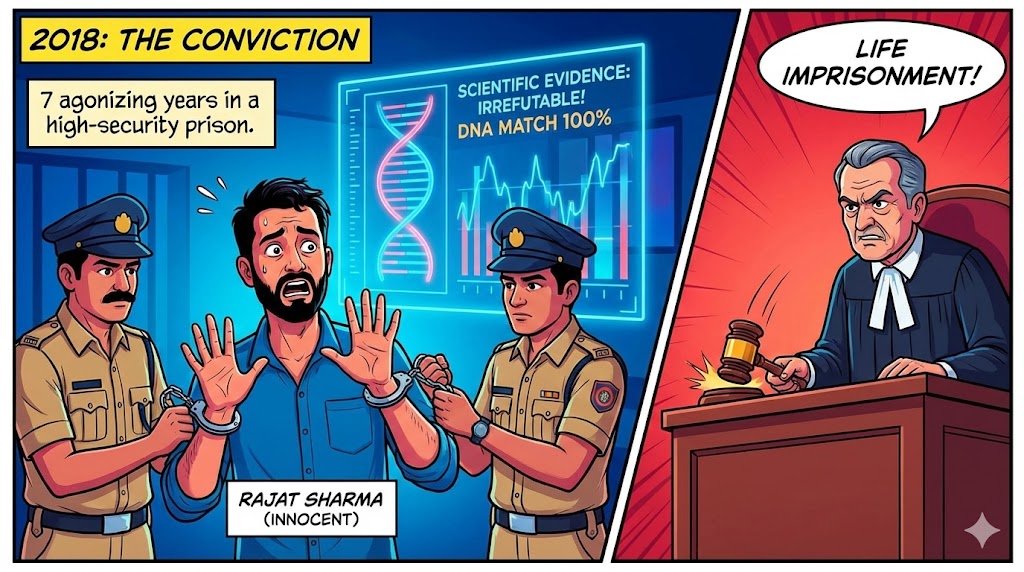
Rajat Sharma's wrongful conviction in 2018 based on DNA evidence

He has now spent 7 agonizing years in a high-security prison.

2025: The Impossible Crime Year 7

The Ghost Returns

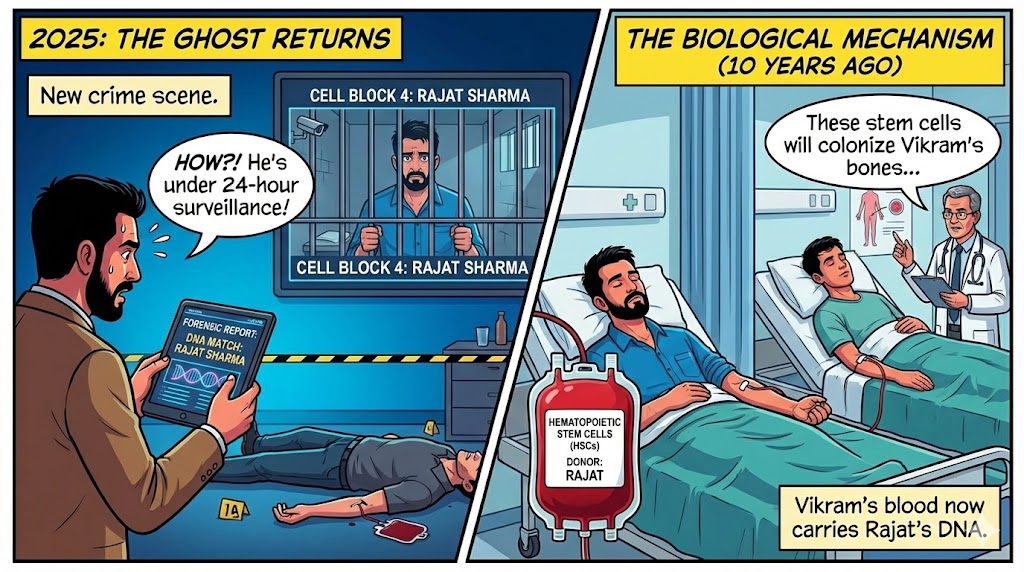
A new murder occurs with the exact same pattern. The killer is injured and leaves blood behind.

Forensics run the DNA. The computer flashes a match: Rajat Sharma.

The Panic: The police superintendent is shocked. "How can Rajat commit a murder in the city when he is sitting in Cell Block 4 under 24-hour CCTV surveillance?"

The Investigation Discovery

The Medical Detective

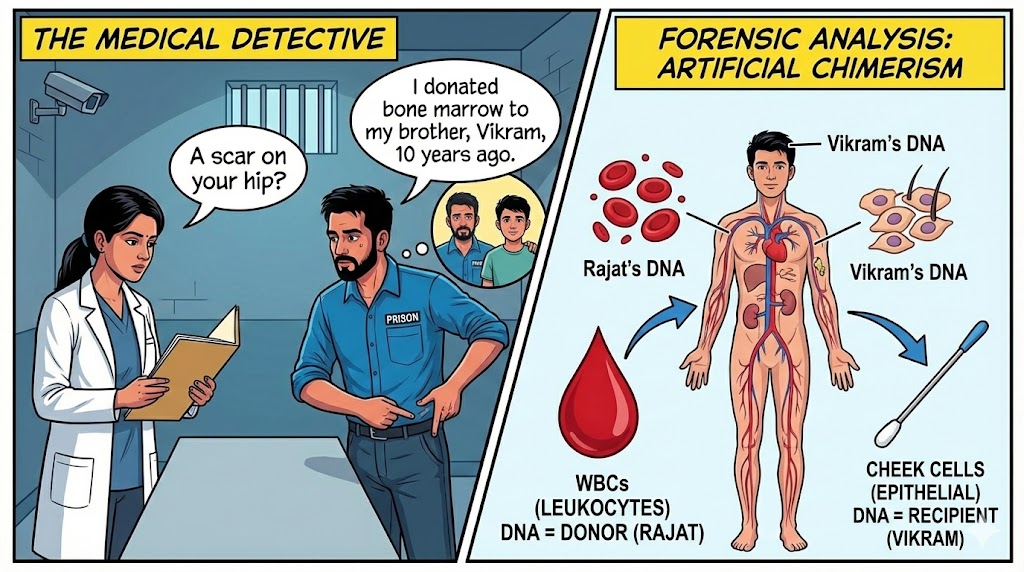
The case is reopened. Dr. Anjali, a forensic specialist, interviews Rajat in prison. She notices a scar on his hip.

"I donated bone marrow to my estranged brother, Vikram, 10 years ago," Rajat reveals. "He had Leukemia. We haven't spoken since."

Police track down Vikram. He is alive, healthy, and... the killer.
Part 2: The Biological Mechanism
Bone Marrow Transplant

Hematopoietic Engraftment

10 years ago, Vikram (The Recipient) underwent myeloablation (destruction of his own marrow using radiation).

He received Rajat's (The Donor) Hematopoietic Stem Cells (HSCs).

The bone marrow transplant process and the resulting DNA match mystery

These stem cells colonized Vikram's bones and started producing new blood. Therefore, Vikram's blood carries Rajat's DNA.

Forensic Analysis

Why Forensics Failed

Forensics rely on Leukocytes (WBCs) for DNA extraction (RBCs have no nucleus).

Since Vikram's WBCs are produced by the donated stem cells, any blood he sheds at a crime scene points to the donor (Rajat).

Dr. Anjali's investigation and the forensic analysis of artificial chimerism

This is a case of Artificial Chimerism: Vikram has his own DNA in his skin/organs, but Rajat's DNA in his blood.

Real World Case Data

The Semen Anomaly

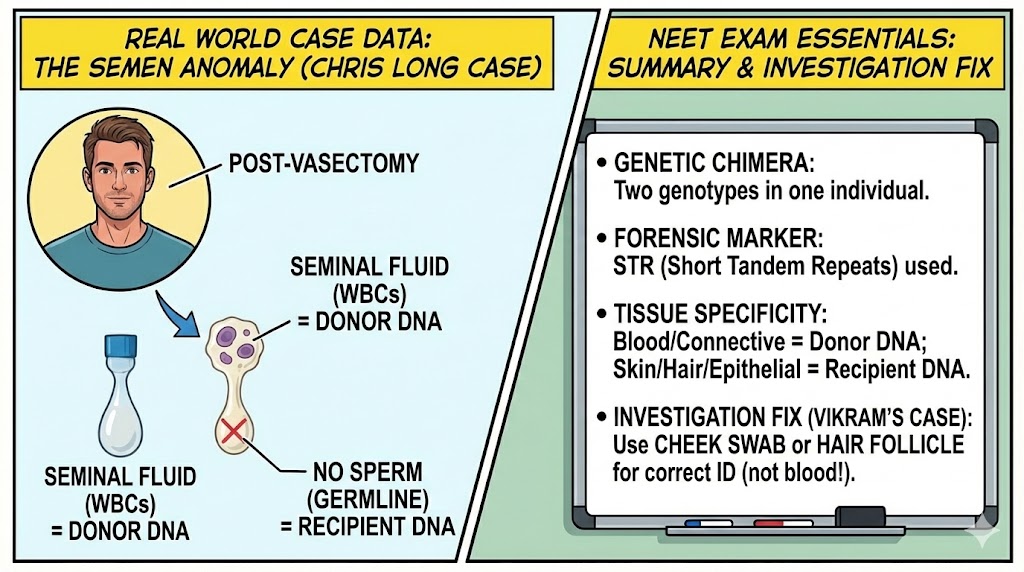
In the real-world case of Chris Long (Nevada), the donor's DNA was found in the recipient's semen.

  • Mechanism: Chris Long had a Vasectomy.
  • Result: His semen contained NO sperm (which would have had his own DNA). It only contained seminal fluid rich in WBCs (Donor DNA).
The Chris Long case data and NEET exam essentials summary

Note: Without a vasectomy, sperm cells (Germline) retain the recipient's original DNA.

Real Case Study: Lydia Fairchild Natural Chimerism

The Invisible Mother

Lydia was accused of fraud because DNA tests said she was not the mother of her own children.

Diagnosis: She was a Tetragametic Chimera 👆 . She had fused with her own fraternal twin in the womb.

Her skin/blood DNA was from "Twin A," but her ovaries (and eggs) were from "Twin B." She was essentially the aunt of her own children genetically.

NEET Exam Essentials

Summary for Aspirants

  • Genetic Chimera: An individual with two distinct genotypes.
  • Forensic Marker: STR (Short Tandem Repeats) are used for DNA fingerprinting.
  • Tissue Specificity:
    ➜ Blood/Connective Tissue = Donor DNA.
    ➜ Skin/Epithelial/Hair Follicle = Recipient (Original) DNA.
  • Investigation Fix: To convict Vikram, police must use a Cheek Swab (Buccal Swab) or Hair Follicle, NOT blood.
NEET Aspirant's Corner

Critical Concepts for Exams

  • What is a Chimera? An organism containing a mixture of genetically different tissues (DNA from two different sources).
  • Does the Sperm change? Generally, NO. The Germline cells (which make sperm/eggs) are separate from Hematopoietic (blood) cells. If Kabir has children, they will inherit Kabir's DNA, not Aryan's.
  • VNTR/STR: Variable Number Tandem Repeats. This is the specific part of DNA analyzed in forensics because it varies highly between individuals.
  • RBCs vs WBCs: Remember, mature Mammalian RBCs are enucleated (no nucleus). DNA extraction from blood relies on WBCs (Leukocytes).